


“Coexisting of Humans and Nature” – Harmonious Coexistence Between Humans and Nature, Achieves Sustainable Development of Peace, Health, and Prosperity.
Will Legend “South China Sea – 350 Blue Ocean Journey” practices “Supporting Social and Economic Development with Marine Ecosystems, and Giving Back to Marine Conservation with Economic Outcomes”, supports United Nations《Conserving And Sustainably Utilizing Marine Ecosystems To Ensure Biodiversity And Prevent Degradation Of The Marine Environment》Sustainable Development Goal (SDG 14).
The Ocean Crossing Journey of Small Algae & Big Whale
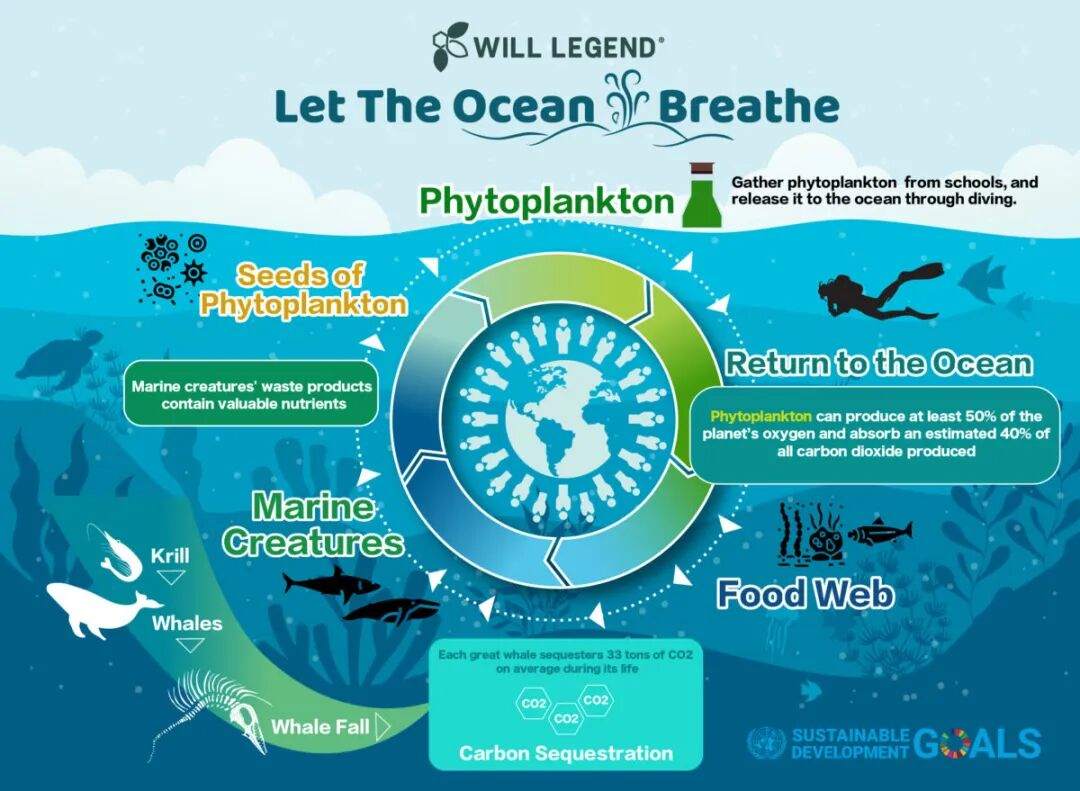
The story begins with the big whales dive underwater to find food and return to the water surface to breathe. Whales bring minerals up to the ocean surface through their vertical movement, called the “whale pump”. From time to time, the big whales migrate their feeding and breeding grounds across oceans, called the “whale conveyor belt”. For every journey, they always bring with their good friends – the tiny algae, or more precisely, the microalgae (Phytoplankton). It turns out that whales’ waste products contain substances — especially iron and nitrogen, the nutrients which phytoplankton need for growing. The is how the tiny algae work with big whales and produce oxygen to the atmosphere.
Safeguard The Ocean, Let the Ocean Breathe  The ocean produces oxygen through the phytoplankton (microalgae). These single-celled photosynthetic marine algae live near the surface. Microalgae are generally very good at turning carbon dioxide, nutrients and water into proteins, fats and carbohydrates through photosynthesis. They provide food for a wide range of sea creatures in a balanced ecosystem. Just like plants, they consume carbon dioxide, make carbohydrates using light energy, produce at least 50% of the planet’s oxygen. Besides, these microscopic creatures absorb about 37 billion metric tons of carbon dioxide (CO2), an estimated 40 percent of all CO2 produced. This is equivalent to the amount of CO2 absorbed by 1.70 trillion trees — four Amazon forests’ worth. Whales accumulate carbon in their bodies during their long lives. When they die, they sink to the bottom of the ocean; each great whale sequesters 33 tons of CO2 on average, taking that carbon out of the atmosphere for centuries. A tree, meanwhile, absorbs only up to 48 pounds of CO2 a year. Therefore, phytoplankton and whales are the excellent examples of carbon sequestration.
Ocean Oxygen Tank
Will Legend educates public, and encourages kids to create their unique “Ocean Oxygen Tank” by planting phytoplankton (microalgae). By growing phytoplankton to learn how these tiny creatures can sequester carbon (carbon sequestration, carbon absorption or carbon fixation), and form the bases of aquatic food webs (primary marine food web) for zooplankton and krill. These zooplankton and krill will become the food sources of other marine creatures including whales. Phytoplankton builds a balanced ecosystem, saving marine creatures and whales. And of course, most importantly, it let the ocean breathe (absorb carbon dioxide and produce oxygen to the atmosphere).
Starting from the “seeds” of phytoplankton, these microalgae will be returned to the ocean. Ultimately microalgae will be transforming into “Ocean Oxygen Tank”. This is the “Green-blueprint” that Will Legend extends from glaciers, lands to oceans, so as to fulfill harmonious coexistence between humans, and nature, achieve peace, health, and prosperity, create a more beautiful Earth for our next generations.
原文來源: 微信公眾號原文